
Introduction
Cricket’s greatest rivalry once again delivered drama, intensity, and high-stakes strategy as India and Pakistan clashed in Colombo. Under humid skies and roaring stands, Pakistan won the toss and opted to field first — a decision that initially looked bold and calculated. But by the end of the night, it was India celebrating a comprehensive 61-run victory after defending 175/7 and bowling Pakistan out for 114.
This wasn’t just a win. It was a masterclass in planning, temperament, and execution.
Pakistan’s Toss Decision: Smart Call, Poor Follow-Through
Winning the toss in Colombo often provides a strategic advantage. Historically, teams prefer chasing due to dew factors and slightly easier batting conditions under lights. Pakistan’s decision to field first suggested confidence in their bowling unit and a clear intent: restrict India under 160 and chase calmly.
For the first few overs, the plan worked.
Pakistan’s pacers bowled tight lines, used variations cleverly, and prevented India from racing away in the powerplay. India looked cautious rather than aggressive. The early momentum slightly tilted toward Pakistan.
However, cricket matches aren’t won in the first six overs — they’re won across phases.
India’s Batting Blueprint: Controlled Aggression
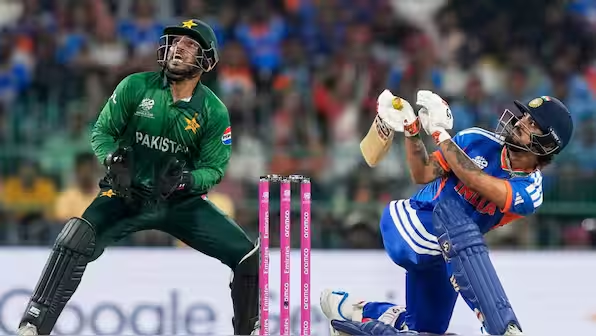
India’s innings of 175/7 wasn’t explosive, but it was intelligently paced.
Phase 1: Stabilization
India focused on preserving wickets in the powerplay. Instead of reckless hitting, they rotated strike, absorbed pressure, and prevented early collapse. The top order understood that Colombo’s pitch wasn’t flat — it required patience.
Phase 2: Middle Overs Acceleration
Between overs 7–15, India shifted gears. The batters targeted Pakistan’s fifth and sixth bowling options, finding boundaries at crucial intervals. Smart strike rotation kept the scoreboard ticking. Even when wickets fell, incoming batters maintained intent rather than retreating into defense.
Phase 3: Death Overs Push
The final overs made the difference. India added valuable late runs with calculated risks — scoops, lofted drives, and aggressive running between wickets. What looked like a 155–160 total became 175, which proved more than competitive.
The key wasn’t power hitting. It was game awareness.
Pakistan’s Chase: Collapse Under Pressure
Chasing 176 required composure and partnerships. Instead, Pakistan lost early wickets that shattered their structure.
Early Blow
India’s new-ball bowlers attacked with disciplined lines. Swing and seam movement created uncertainty. Pakistan’s top order played across the line and paid the price.
Losing two wickets inside the powerplay forced Pakistan into a defensive mindset — exactly what India wanted.
Middle Overs Meltdown
Here is where the match truly slipped away.
Instead of rebuilding patiently, Pakistan’s middle order attempted risky shots against spin. India’s spinners slowed the pace, varied lengths, and forced errors. Dot-ball pressure mounted. The required run rate crept up. Panic followed.
Wickets fell in clusters.
There was no significant partnership, no anchor innings, and no batter willing to absorb pressure. Once momentum shifted, Pakistan struggled to regain control.
Tail-End Resistance?
There wasn’t much.
India’s field placements were aggressive — catching positions in play, pressure from all angles. Pakistan were bowled out for 114, well short of the target.
Key Differences Between the Two Teams
1. Temperament Under Pressure
India handled pressure better. When wickets fell, they rebuilt. Pakistan, on the other hand, panicked once early wickets went down.
2. Middle Overs Strategy
India accelerated in the middle overs. Pakistan stagnated. That difference alone created a gap of 40–50 runs.
3. Spin Utilization
India used spin as an attacking weapon. Pakistan treated it defensively. The spinners didn’t just contain; they hunted wickets.
4. Fielding Intensity
India’s fielding energy was visibly sharper — diving stops, tight inner ring, and attacking field placements. Pakistan looked slightly reactive rather than proactive.
5. Game Awareness India played the conditions. Pakistan seemed to play the occasion.
Where Exactly Did Pakistan Lose the Match?
The match was not lost at the toss.
It wasn’t even lost in the first innings.
Pakistan lost the game between overs 7 and 15 of their chase.
That phase saw:
- Dot-ball pressure
- Poor shot selection
- Lack of communication between batters
- Absence of a stabilizing partnership
Instead of targeting weaker bowlers, they tried forcing boundaries against India’s best spinners. The required run rate climbed above nine, then ten. From there, it became damage control.
In high-pressure India-Pakistan matches, momentum swings are brutal. Once India sensed vulnerability, they attacked relentlessly.
Tactical Lessons from the Game
- A par score depends on bowling strength.
175 wasn’t massive — but it was more than enough with disciplined bowling. - Middle overs decide T20-style contests.
Powerplay sets tone; death overs create headlines; middle overs win matches. - Partnerships are gold.
India had small but crucial stands. Pakistan had none of substance. - Pressure forces mistakes.
India created it. Pakistan succumbed to it.
Final Verdict
This 61-run victory was a statement performance from India — built on structure, clarity, and patience.
Pakistan showed flashes of promise with the ball early on but failed to translate momentum into sustained pressure. Their batting lacked adaptability when conditions demanded composure.
In marquee clashes like this, margins are psychological as much as tactical. India stayed calm. Pakistan hurried.
Colombo witnessed another chapter in cricket’s fiercest rivalry — one where planning defeated passion and discipline outshone aggression.
And when the dust settled, India stood tall with a convincing 61-run triumph.